
Chimney caps
Chimney cap: the small part that keeps rain and debris out of the flue
A chimney cap is the covered metal hood fixed over the top of a flue. The Chimney Safety Institute of America (CSIA) says a well-designed cap keeps out rainwater, and water does more damage to masonry chimneys than fire. A screened cap also keeps out leaves, birds and animals that would otherwise block the flue.
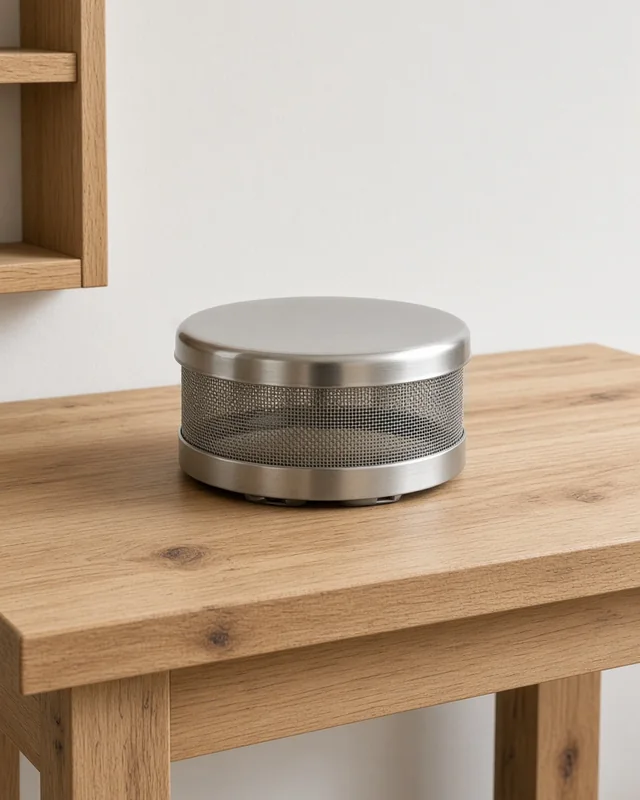
What does a chimney cap do?
An open flue is a vertical pipe pointed at the sky. Every rainstorm drops water straight down it, onto the smoke shelf and the damper, where it rusts metal, soaks the masonry from inside and mixes with soot to make the sour smell many owners notice in damp weather. A cap puts a roof over that opening. Its main jobs:
- Rain. The hood sheds water that would fall into the flue.
- Debris and animals. The mesh sides stop leaves, twigs and nesting birds or squirrels, any of which can block the flue and push smoke and gases back into the house.
- Wind. Some cap designs are made to steady the draft on chimneys that suffer from downdrafts. Those are specialty caps chosen for a known problem, not a default.
Cap or crown: which is which?
The two are often confused because both sit at the top. The crown is the masonry or concrete slab that covers the top of the brick around the flue; it protects the masonry. The cap is the metal hood over the flue opening; it protects the inside. A chimney needs both, and a good cap does not make up for a cracked crown. Our chimney repair guide covers crowns.
Kinds of chimney cap
- Single-flue caps fit over one flue tile that sticks up above the crown, clamped to the outside of the tile or fixed inside it. The most common kind on masonry chimneys.
- Multi-flue (top-mount) caps cover the whole crown on a chimney with more than one flue, such as a fireplace flue next to a furnace flue. They are fastened to the crown and cover all the flues at once.
- Caps for factory-built chimneys are part of the listed system made by the fireplace's maker. Replace them with the maker's matching part, since the cap is part of what the fireplace was tested with.
- Top-sealing dampers combine a cap with a damper at the top of the flue, closed by a cable from the firebox. Useful where the original throat damper has rusted out.
Stainless steel and copper outlast galvanized steel, which rusts and stains the crown. Whatever the metal, the mesh should be sized so it keeps animals out without clogging with soot quickly; a screen choked with deposit restricts the draft and needs cleaning at each sweep.
Fitting a cap: what to ask
- Measure the flue, not the chimney. The cap is sized to the flue tile's outside dimensions and how far it sticks up above the crown.
- Check the crown first. Fixing a cap to a cracked crown wastes the cap. Ask the installer to look at it.
- Height clearance. The hood must leave enough opening above the flue for the smoke to leave freely.
- Fastening. A cap that blows off in the first windstorm protects nothing. Ask how it is fixed.
- Gas and appliance flues. A gas or furnace flue may need a cap made for that appliance; ask before a general one goes on.
Going onto a roof to measure or fit a cap is work for someone with the right ladder, harness and experience. From the ground, binoculars show whether a cap is there and whether it is rusted, bent or missing its screen.
Signs a cap is missing or failing
- Water dripping onto the damper or into the firebox during rain.
- A rust-streaked crown or rust flakes in the firebox.
- Leaves, sticks or nest material falling when the damper is opened.
- Bird or animal sounds in the chimney in spring.
- A damp, sour smell from the fireplace after wet weather.
Animals in a flue need careful handling: what is up there, and whether young are present, decides how it is removed. Do not light a fire to drive them out, since smoke backing up from a blocked flue fills the room. A chimney professional can clear the flue and fit a cap the same visit.
Caps and spark arrestors
Many caps include mesh that also acts as a spark arrestor, catching embers before they reach the roof. In fire-prone parts of California, local fire codes may ask for one; check with your city or county building department before choosing a cap without mesh. The yearly inspection is also a good time to have the mesh cleaned, since a soot-clogged screen chokes the draft.
Chimney cap
Missing or rusted chimney cap?
Tell us what you see at the fireplace or chimney. We call or email you back about the kind of visit you need; the request is free.
Ask about a chimney cap
A few lines are enough: what kind of fireplace or stove you have, what you are noticing, and the city or ZIP. We call or email you back about the visit you need; sending this costs nothing.
Chimney cap questions
Does every chimney need a cap?
Any flue open to the sky takes in rain and debris, so a cap is worth having on nearly every masonry chimney. A factory-built chimney already comes with the maker's cap, which should be kept in place and replaced only with the matching part.
Can a chimney cap cause smoke to come back into the room?
A cap that is too low over the flue, or whose mesh is clogged with soot, can restrict the draft. Have the mesh checked and cleaned at each sweep, and make sure the hood leaves enough open height above the flue.
Should the chimney be swept before a new cap goes on?
It is sensible. A flue that may already hold leaves, a nest or heavy deposit should be cleared and looked at before it is covered, so nothing is trapped under the new cap. Many companies fit caps on the same visit as a sweep and inspection.
Sources: CSIA, water and masonry chimneys: caps, crowns and flashing (June 11, 2010) and Homeowner resources; U.S. Consumer Product Safety Commission, Home heating equipment.